- Cinematic Fanatic
- Posts
- The Fall of Will Smith
The Fall of Will Smith
Plus: McConaughey as Mike Hammer, Sir Gary Oldman, Osgood's hidden demons, and Ryan Coogler Criterion picks.

Brock Swinson
June 18, 2025

👋 Your watchlist just got better.
🎥 28 Years Later | 6.20
🎥 Pixar’s Elio | 6.20
🎥 Bride Hard* | 6.20
*We spoke with Anna Camp about Bride Hard and You right here.
TRENDING
📚 Black Panther director Ryan Coogler browses The Criterion Closet, and Seth Rogen and Evan Goldberg also visit.
🕵️ Matthew McConaughey returns to detective mode as Mike Hammer in new film from True Detective creator Nic Pizzolatto.
🍺 First teaser drops for King of the Hill revival series (yep, Bobby is all grown up), premiering August 4 on Hulu.
👹 Osgood Perkins reveals hidden demon cameos lurking in Longlegs backgrounds, tracking Maika Monroe throughout Nicolas Cage horror hit.
🏈 Glen Powell disguises as talented quarterback "Chad Powers" to infiltrate struggling Southern football team in Hulu comedy, September 20.
🌪️ Take Shelter extras promised free lunch had no idea Michael Shannon would unleash that unhinged performance on them.
👑 Gary Oldman receives knighthood from King Charles, officially becoming Sir Gary Oldman.
🔫 First clip from Zach Cregger's Weapons shows classroom of children mysteriously vanishing from their beds overnight.
🎭 If you loved Shrinking and The Studio, this Actors on Actors with Seth Rogen and Jason Segel is essential viewing (this too).
FEATURE
🎬 The Fall of Will Smith

The Oscar slap will forever define March 27, 2022, but Will Smith's downfall didn't start with Chris Rock. It began decades earlier with a pattern of spectacular misjudgments that reveal how Hollywood's biggest star became his own worst enemy.
Smith famously called turning down The Matrix one of his "beautiful scars." When the Wachowskis pitched him Neo in 1997, their vision didn't translate. "We're thinking like… imagine you're in a fight. You, like, jump. Imagine if you could stop jumping in the middle of the jump," Smith recalled them explaining.
He chose Wild Wild West instead—a decision that cost him an estimated $200 million and cultural immortality. "As it turns out, they're geniuses, but there's a fine line in a pitch meeting between genius and what I experienced in the meeting," Smith later admitted.
Will Smith reveals that he turned down the lead role in Inception.
— Christopher Nolan Art & Updates (@NolanAnalyst)
6:59 PM • Jun 15, 2025
The Inception Confession: History Repeats
In a bombshell revelation this week, Smith admitted: "Chris Nolan brought me Inception first and I didn't get it. I've never said that out loud." The pattern was identical—another visionary director, another incomprehensible pitch, another billion-dollar mistake. "Now that I think about it, it's those movies that go into those alternate realities, they don't pitch well," he explained. "But I'm hurt by those two."
Smith developed a calculated approach to his career: alternate between massive blockbusters and prestige projects. Independence Day led to Six Degrees of Separation. Men in Black preceded Ali. This strategic rotation kept him relevant across demographics while chasing both box office gold and Oscar recognition.
Smith set for himself the goal of becoming "the biggest movie star in the world," studying box office successes' common characteristics. But this formula created a dangerous obsession with winning over artistry.
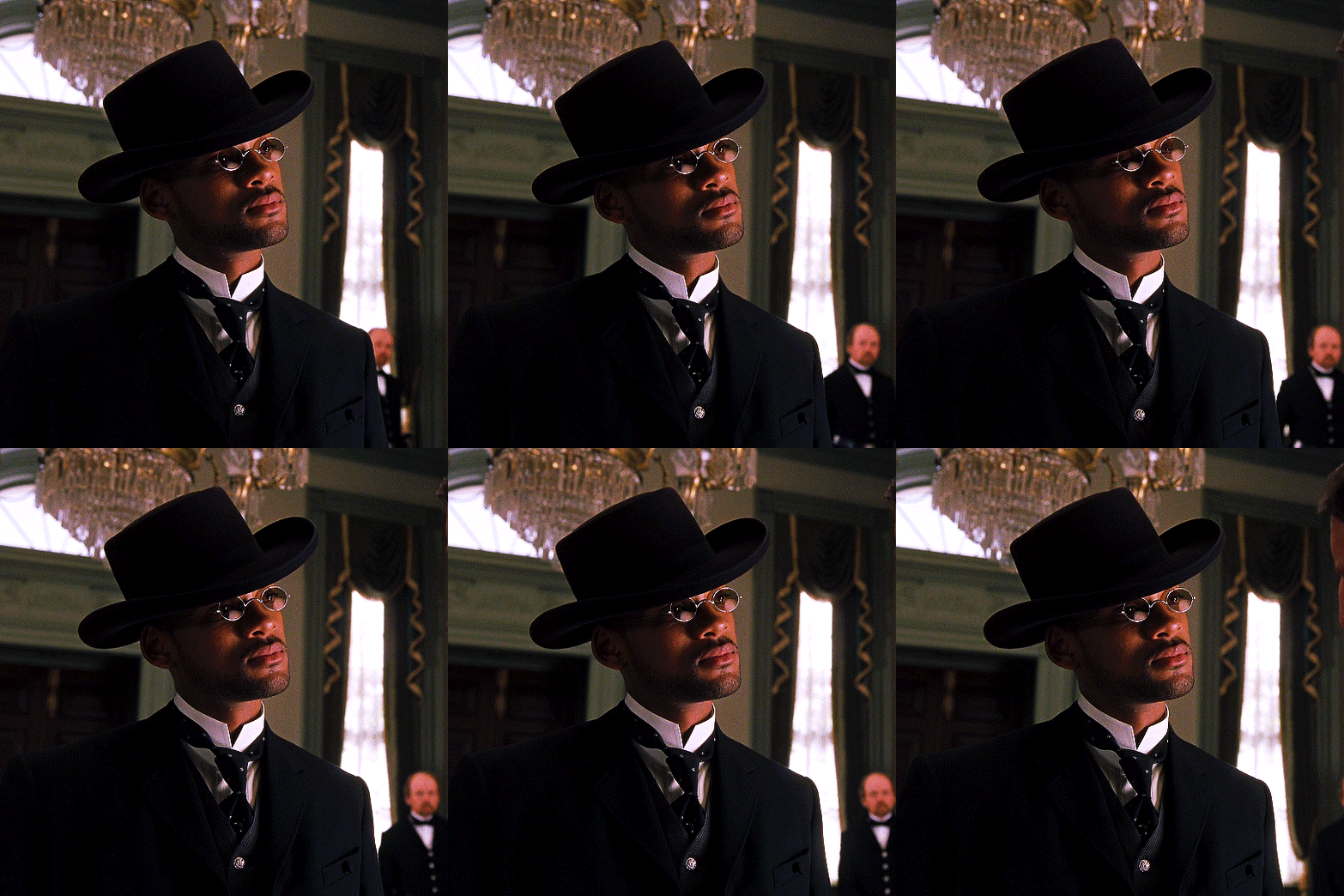
The Wild Wild West Disaster: When Ego Overrode Instinct
"I had so much success that I started to taste global blood and my focus shifted from my artistry to winning. I wanted to win and be the biggest movie star," Smith confessed about Wild Wild West. "I found myself promoting something because I wanted to win versus promoting something because I believed in it."
The $170 million bomb earned five Razzie Awards and taught Smith a brutal lesson. "Wild Wild West is just a thorn in my side. To see myself with chaps...I don't like it."
Then there was the father-son failure. "That was the most painful failure in my career," Smith said of 2013's After Earth. "Wild Wild West was less painful than After Earth because my son was involved in After Earth, and I led him into it. That was excruciating."
The M. Night Shyamalan disaster earned a 12% on Rotten Tomatoes and sparked a family crisis. "At 15 years old, when Jaden asked about being an emancipated minor, my heart shattered," Smith revealed. "We never discussed it, but I know he felt betrayed. He felt misled, and he lost trust in my leadership."
The Pattern of Self-Sabotage
Smith's career reveals a man perpetually at war with his own instincts. He rejected Django Unchained, passed on Rush Hour, and built an empire on spectacle while yearning for respect. "I think that my strength is I can do everything well," he once said—but his greatest weakness was believing he always knew better than the visionaries pitching him.
The Oscar slap wasn't an aberration—it was the culmination of decades of ego-driven decisions. A man who built his career on control finally lost it completely, in front of the entire world. Smith had spent 30 years making beautiful mistakes in private; on March 27, 2022, he made his ugliest one in public.
Note from the Publisher: If it wasn’t for “the slap,” Will Smith’s book likely would have a been as talked about as McConaughy’s Greenlights. Check it out here.
PUNCHLINES
this iconic franchise >>>>
— Letterboxd (@letterboxd)
12:48 AM • Jun 17, 2025
New poster for ‘THE NAKED GUN’ reboot, starring Liam Neeson and Pamela Anderson.
In theaters on August 1.
— DiscussingFilm (@DiscussingFilm)
4:01 PM • Jun 15, 2025
"Everywhere I look, something reminds me of her"
— Parody/Spoof/Satire Clips (@NoContextSpoof)
7:23 PM • Jun 16, 2025